The fossil record has a lot to say about the effects of climate change.
We can see the sensitivity of the world’s
ecosystems; we can see how life responds to temperature changes; and we can put
the current trends in perspective. While we can’t go back and read a
thermometer, we can look at preserved temperature proxies, like oxygen and
hydrogen isotopes. These heavier isotopes get trapped in polar ice sheets
15 and
the shells of creatures on the ocean floor and we can relate their abundances
to specific average global temperatures.
 |
| Thrinaxodon fossil |
When you look back at the history of life two big warming events stand
out.
The first follows the
Permian-Triassic mass extinction.
Isotopic
data from fossilized Benthic remains in China shows that equatorial surface
waters, at that time, reached around 40 degrees Celsius. Today equatorial
surface waters average around 27C. To put that in prospective, 40 degrees
C is 104 degrees F, most hot tubs are set to 102 degrees F.
4 The world was incredibly
hot and life struggled.
The extreme temperatures
and CO2 levels found during that period are believed to be responsible for long
lag time in the recovery life’s biodiversity.
The species that managed to survive the mass extinction merely clung on
to life, but nothing thrived in the heat. In fact all mammals owe their
existence to one survivor of that period, Thrinaxodon, a small burrowing
carnivore, who was the lone mammal-like reptile to survive the period. That’s
how close WE came to not being.
20
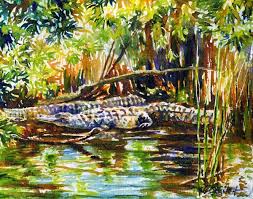 |
| Water Color of alligators in a mangrove swamp |
Another period of rapid global warming took place 55 million years ago and
is known as the Paleocene-Eocene Thermal maximum. Isotopic data from the Arctic
Coring Expedition show an average temperature of 23.3C or 74F for the Arctic
Circle during that time.
When you
combine the isotopic data with fossilized palm trees and crocodilian remains
found in the same cores, you start to get the image of an arctic circle that
looked more like the Everglades do today then the frozen tundra we know.
1 This warming event opened up previously
inhospitable terrain and saw great migrations between the continents and
may have sparked the great diversification seen in the age of mammals.
21
The first of these warming events nearly ended
the mammalian line entirely, while the second spurred a period of great
migration and radiation, so it’s hard to tell what end result of the current
warming will be. Climate change tends to
bring 4 types of changes in mammalian populations:2
- The relative abundance at the species level shifts
- The taxonomic makeup of any given area changes
- Species richness changes
- Phenotypic
expressions can alter.
The
bottom line is everything is subject to flux, and in the face of such
unpredictable futures it seems detrimental to be tightly linked to any one way
of life or to any one other creature.
The Canadian Lynx is tightly linked to both its terrain and its prey and
that doesn’t bode well.
Thrinaxodon photo by Allison Beck
Mangrove Water Color by Jennifer Branch. Available at jenniferbranch.com

No comments:
Post a Comment