Global warming brings about another type of shift that is less about
longitude and latitude and more about time. Phenological shifts are changes in
the timing of life events like when mating occurs or when pollen is ready for
dispersal and are generally referred to as trophic mismatch.
Shifts in the timing of life cycle at one
trophic level can severely impact the fitness of other trophic layers.
If predators are not around at the proper
time you can get over-grazing and a loss of biodiversity.
6 If food sources are
not ready on time both offspring and mothers can see a greatly reduced survival
rate.
The collapse of one trophic layer
can often cascade through an ecosystem.
Secondary consumers have been identified as the most likely to suffer
from trophic mismatch due to a lag in reaction time,
18 which would include both the Bobcat and the Lynx.
 |
| Canadian Lynx kitten |
The Canadian Lynx has a second layer of risk as it has been shown that the Lynx
will differentially reproduce based on the abundance of snowshoe hares.
14 This behavior can greatly reduce stress on
the cat populations in lean years and help conserve resources.
However, trophic mismatch could produce false negatives
that result in reduced Lynx populations if the Lynx’s seasonal breeding takes
place too early.
Another potential
situation could arise if the hares breed before their food sources are ready to
support them, as the resultant population would overgraze and strip out its
food sources.
The large hare population
would cause the Lynx to over produce but the stripped food sources would be
unable to support the hare population the following year and could lead to
complete collapse from lack of food and over predation.
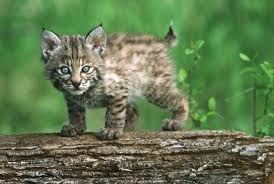 |
| Bobcat kitten |
While the Lynx mates seasonally and only proportionally to hare populations
the bobcat is extremely flexible in its mating habits. In harsh conditions it
will mate seasonally to conserve resources and improve survival chances. This
is typical of northern populations that face harder winter.
In less seasonal environments the bobcat will
mate year round.
14 This is another example
of the bobcat’s flexibility and could represent a true asset if increased
breeding allows for exploitation of vacated niches opened up because of range
shifts.
Lynx kitten taken by Robert Barber
Bobcat Kitten taken by James Craner

No comments:
Post a Comment