 |
| Smilodon fatalis skull from the page museum |
If you have never been to the Page Museum at the La Brea tar pits in
California, you really should.
The
liquid asphalt provides a time capsule back into the past.
The full cast of characters that roamed
California from 50 to 10 thousand years ago is exquisitely preserved.
One such character is the saber tooth cat
Smilodon fatalis, which is known from
the remains of over 2000 individuals just from La Brea alone.
The bones of this cat paint the picture of a
massive muscle-bound ambush predator.
Who
it preyed upon and why it disappeared around the end of the last ice age may
never be fully understood, but one credible explanation of its life and death brings
with it bad tidings for the Canadian Lynx.
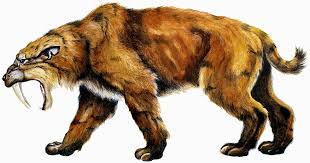 |
Artist reconstruction of Smilodon fatalis
|
Reconstructions of
Smilodon fatalis
show an animal with massive arms and shoulders.
This was the Hulk Hogan of cats and its remains bear the wounds to prove
it.
Strains, stresses and other injuries
consistent with a very violent life of grabbing large prey and wrestling them to the ground are not only common in smilodon but the norm.
This cat didn’t chase its prey like a modern
lion, its body style was simply wrong for it.
Most biomechanical simulations don’t give it the speed to catch much of anything.
It was simply a lumbering brute capable of
amazing feats of strength and well suited for the deep woods.
Analysis of what it could catch and bring
down all seem to point to the enormous giant bison of that time.
5
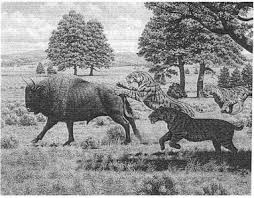 |
| Smilodons chasing a bison |
One theory presented on National
Geographic’s Prehistoric Predators hypothesizes that as the forests of the last
glacial period gave way to grasslands the bison made a transitions to the more
open terrain and became smaller and faster. The saber tooth cat was unsuited
for chasing down prey in open grasslands and found its traditional food source
uncatchable.
5
Faced with the ecological disintegration caused by warming at the end of the
last ice age the highly specialized cat couldn’t adapt.
If the bison really was the only prey the
saber tooth cat ate as some researchers suggest, then it appears that evolving
to hunt specific prey in a specific environment lead to diminished flexibility.
That eventually meant the end of
Smilodon
fatalis despite 2.5 million years of success.
Skull photo taken by Simon Powell.
Reconstuction from the Indiana State Museum
Original drawing by Mauricio Anton from The Big Cats and their fossil relatives by Alan Turner

No comments:
Post a Comment